
Can you ask salaried staff to clock in?

Yes, in the US, if they are exempt. Under US federal law an employer may require an exempt salaried employee to record and track their hours. A partial-day absence cannot cut that person’s pay, except in the narrow cases the rules name. This post covers US federal law, and India’s rule in its own section.
Who the rules cover
The rules cover employees who are exempt under section 13(a)(1) of the Fair Labor Standards Act as bona fide executive, administrative, and professional employees, as DOL’s opinion letter FLSA2005-16 describes them, and who are paid on a salary basis as 29 CFR 541.602 defines that term.
Asking for the record keeps exempt status
DOL’s explanation of its 2004 rule says that employers, without affecting their employees’ exempt status, “may require exempt employees to record and track hours” (69 FR 22178).
Use the record for three things: coverage when a shift is short, a conversation about lateness, and a check on the schedule staff were asked to work. None of the three changes pay.
Output is still the final test for salaried work.
A partial day comes out of leave, not salary
Under 541.602(a)(1), an exempt employee must receive the full salary for any week in which they perform any work, subject to the exceptions. A late start or an early finish in a week with work is not a pay cut under that rule.
DOL’s preamble says partial-day deductions should continue to be permitted only for safety rules of major significance, for FMLA leave, and in the first and last weeks of employment. Check any partial-day deduction against those three cases before you make it.
A partial day can come out of leave. The Handbook allows the debit while the employee still receives the full guaranteed salary (§22h05(d)(1)), and requires the full salary once no accrued leave is left (§22h05(d)(2)). Set payroll so that a partial day comes out of leave while leave lasts, and the full salary is paid after that. If a partial-day deduction turns out to be improper, reimburse it at once.
Full days can come out of salary
Deductions may be made when an exempt employee is absent for one or more full days for personal reasons, other than sickness or disability (541.602(b)(1)). An unpaid disciplinary suspension must be one or more full days, imposed in good faith for infractions of workplace conduct rules under a written policy applicable to all employees (541.602(b)(5)). Unpaid leave under the Family and Medical Leave Act can be deducted in proportion (541.602(b)(7)).
Attendance can go into a review
Under the FLSA, attendance can go into a review, except FMLA leave. Employers cannot use FMLA leave as a negative factor in employment actions (29 CFR 825.220(c)), and DOL’s letter says using it in a performance evaluation “would be considered discrimination.” Before an absence goes into a review, check whether it was FMLA leave.
India’s rule
In India, the Code on Wages, 2019 does not stop you asking staff to clock in. The sections named below have been in force since 21 November 2025.
For an establishment with 300 or more workers, the Service Sector Standing Orders, 2026 require each worker to register attendance at the start and close of the shift (para 10(3)). Until the establishment’s own orders are certified, these model orders are deemed adopted. Whether the Centre’s or a state’s model orders apply to an ordinary private office is unsettled.
The Code’s definition of employee (s.2(k)) names managerial work. For an employee the Code covers, a partial-day absence can cut pay, pro rata: the deduction covers absence from the place of work for any part of the required time, and may not exceed the absent share of that time in the wage period (ss.18(2)(b), 20).
The Code requires a register of persons employed, muster roll and wages, with the other details the rules prescribe (s.50(1)). The Code on Wages (Central) Rules, 2026, in force since 8 May 2026, name an Attendance Register-cum-Muster Roll in Form IX, with the time in and out each day, kept five years after the last entry (rule 51). Check the rules of the state where your staff work before you choose a form.
Use the clock-in record in Workfolio
Workfolio’s employee attendance clock-in software has a desktop app that makes it easy to clock in, clock out or take a break whenever needed. Three steps show the record in Workfolio’s own screens.
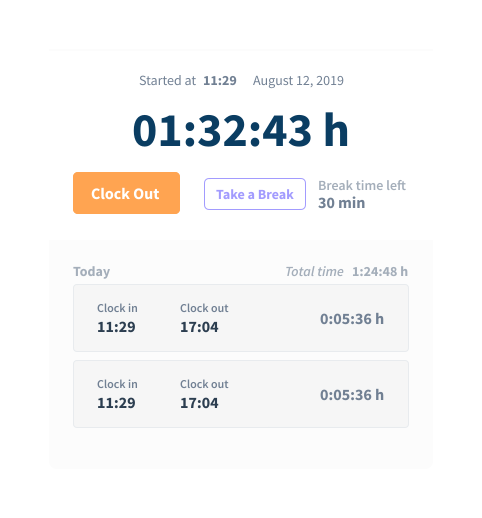
The employee clocks in from the desktop app. Workfolio tracks only while the employee is clocked in. The screen then shows the time since they started, the break time left, and each clock-in and clock-out for the day. Time taken with Take a Break counts as break time.
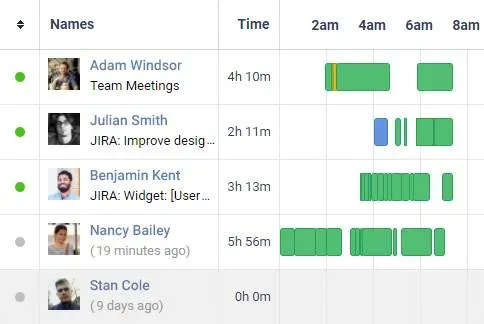
Read the day on the timeline. Workfolio’s daily timeline is a visual log of every employee’s day, broken down to productive time, idle time and break time. A late start shows as activity that begins later on that person’s row.
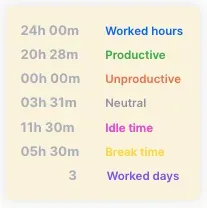
Read the hours on the totals card. Worked hours split into productive, unproductive and neutral time, with idle time, break time and the number of worked days beside them. Hours come from computer activity, so read them beside the work the person delivered.
Outside the US, check the local law
The US rules above cover federal law only. Check your state’s rules as well. If your staff work in another Asian market, this post does not answer the question for them. Check the local labour law on three points: whether a salaried employee’s pay can be reduced for a partial day, whether the law requires a record of hours for salaried staff, and what the written contract and policy say. Ask a local adviser before you set a clock-in rule.
Tell your team before the first clock-in
Settle the three uses above and the partial-day rule under the law that applies to your staff. Then put both in the note your team gets before the first clock-in: what the record is for, and how a partial day is treated.

