
Can you use monitoring data to discipline or dismiss an employee?

Yes, where the record is checked against other evidence and the person’s explanation is weighed. Two Canadian decisions found just cause for dismissals that relied on monitoring data. Neither is a rule for your workplace, so check the rules where your staff work before you act.
Two Canadian decisions found just cause on monitoring data
In Ontario, Canada, an arbitrator dismissed a union’s grievance against an employee’s discharge in Enbridge Gas Inc. v Unifor, Local 975, 2023 CanLII 2937. The evidence was vehicle GPS, not desktop monitoring: each of the company’s vehicles carried a device. The arbitrator found that the company had just cause.
In British Columbia, Canada, a small claims decision of the Civil Resolution Tribunal, Besse v. Reach CPA Inc., 2023 BCCRT 27, found that the employer had just cause to dismiss. The evidence was a time-tracking program on her work laptop.
Five steps before a record is relied on
Take these steps in order, before any record is used. Steps two to four are the ones both Canadian decisions show. Steps one and five are our advice.
Tell the team before any record is used
Tell the team what is collected, why, and who looks at it, before any of the data is used on anyone. Neither Canadian decision turns on advance notice, so this step is our advice.
The Canadian arbitrator also weighed a Statement on Business Conduct, which the employee “clearly knew and understood to be a fundamental term of his contract of employment.” Put your own rules in writing, and make sure each person has them.
Compare the record with the work
Output is the final test, so start from the work the hours were for. Workfolio tracks only while the employee is clocked in. Within that time, a computer record cannot see a call, a meeting, or reading on paper. In the Canadian tribunal decision, the employee said she had spent a significant amount of time on paper copies of client documents, which the program would not have captured.
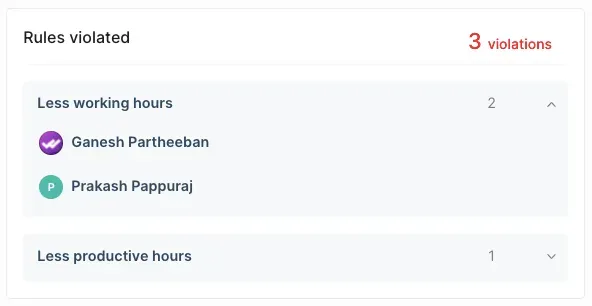
In Workfolio’s user activity monitoring, check the record in this order. Start with the rules panel. It lists each rule, the number of people it flagged, and their names. A flag only points to hours to check.
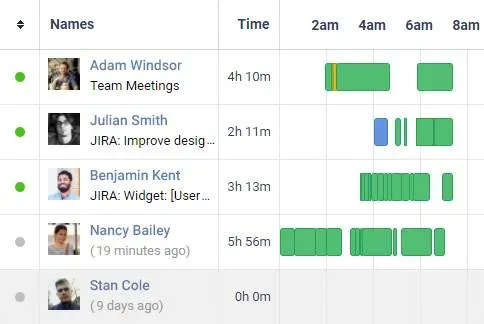
Then open the timeline for the person and the day in question. It is a visual log of each person’s day, broken down to productive time, idle time and break time.
Where a stretch needs a closer look, open the capture for it. If captures are blurred, the window’s contents are hidden, but the app, the capture time, and the person’s name and team still show.
Then read the totals card for the period. It shows worked hours and worked days, with productive, unproductive and neutral time within the worked hours, and idle time and break time beside them. Time taken with Take a Break counts as break time.
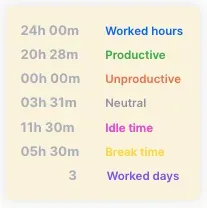
Set those totals beside the schedule, the timesheets, and the assignments you hold. In the Canadian arbitration, the company checked the GPS records against the employee’s daily route schedule and his submitted timesheets. In the Canadian tribunal, the employer’s analysis found 50.76 hours she had reported on her timesheets but did not appear to have spent on work-related tasks.
Set out the hours in question
Before the meeting, write down each stretch in question: the day, the times, and what the record shows for it. Show the person those hours first.
In the Canadian arbitration, the company interviewed the employee by videoconference, with two union representatives present, to explain the results of the initial GPS inquiry. In the Canadian tribunal, the employer explained its analysis to her, including its concerns about the unaccounted hours.
Let the person answer
Offer time to answer, and weigh the answer against the record. Write down the offer, including when it is declined.
In the Canadian arbitration, the company asked the employee back for a second interview, again with union representatives present, to review the GPS data. The computer logs were used to test his explanation. They showed that he sent or answered e-mails “to a negligible degree.”
In the Canadian tribunal, the employer offered her time to consider the information and get back to it. She declined. The tribunal still weighed her account of paper copies against the printing data.
Decide on the whole, not one total
A single total shows where to look. It does not show what the work was or why the time went unrecorded. Ask the person, check the output, and decide on the whole.
The Canadian arbitrator found that over a period of at least five months, the employee did not attend his assigned work on numerous occasions, without justification, and charged the company for it. The Canadian tribunal found the tracking likely accurate after weighing it against her explanation.
India requires an enquiry before punishment under standing orders
Under standing orders, a worker can be punished for misconduct a record shows only after an enquiry in which the worker hears the charges and is heard on the penalty. The Industrial Relations Code, 2020 applies its standing-orders chapter to an industrial establishment with 300 or more workers.
Until an establishment’s own orders are certified, the model orders are deemed adopted. The Service Sector Standing Orders, 2026 list misconduct including habitual late attendance and habitual absence without leave or sufficient cause, habitual neglect of work, and unauthorised access to any IT system or computer network of the employer, customer or client. Whether the Centre’s or a state’s model orders apply to an ordinary private office is unsettled.
In the enquiry, the worker is entitled to appear in person or be represented by an office-bearer of a trade union of which they are a member or a co-worker of their choice.
The Supreme Court says, in Workmen of Balmadies Estates v. Management, [2008] 1 S.C.R. 867, that in a domestic enquiry proof of misconduct is enough, and that logically probative material, hearsay included, can be acted on if it has a reasonable nexus and is credible. So put the record to the worker in the enquiry.
From 13 May 2027, the Digital Personal Data Protection Act, 2023 requires data used to make a decision that affects a person to be complete, accurate and consistent (section 8(3)).
A tribunal that finds a dismissal not justified may set it aside, order reinstatement, or give other relief, including a lesser punishment (section 50(1) of the same Code).
Managers and higher-paid supervisors are not “workers” under the Code, and an establishment with fewer than 300 workers has no statutory standing orders. For both, what procedure applies beyond the contract is unsettled.
Check the rules where your staff work
Each Canadian decision is one case between its own parties, made in one place, and neither is a rule for your workplace. India’s rule is in the section above. Outside India, before you act on a record, check whether the law where your staff work requires notice of monitoring, what a dismissal must include there, and whether a monitoring record may be used there to support one. Take those questions to an employment adviser who works there.

